Showing posts with label European Union. Show all posts

Thursday, 14 January 2010

Some stuff I've seen recently

Some bits and pieces that I have spotted recently which you may want to peruse.


Joseph Stromberg  discusses the enclosure of land in England and  collectivisation of agriculture in the Soviet Union.

Some brain food for the person in your life who thinks 'My European Union, Right or Wrong'.

Is there an anti-war 'Right' in the USA and can it co-operate with the 'Left' (and vice-versa)? (Hat-tips: antiwar.com and Leif Brecke!)


Meanwhile Michelle Bachmann is being touted as the new Sarah Palin for the Neo-Cons and Born-Agains who appear to dominate the Republican Party in the US. However, she is hardly the anti-statist her public image would suggest...(H-T: Leif B again!)

It is from the Republican No-Nothings that an awful lot of the nonsense about Barack Obama comes from and the internet is a way they spread their notions ('ideas' may be too strong a phrase), as Robin Ramsay shows. (you may have to register to read this link- it's free though!) BTW the latest issue of  Lobster can now be downloaded for free!

As the China v Google stand-off starts, it is pretty clear that battles over the internet, access to it and surveillance of it will become increasingly important in the decade to come. (This came my way as I was putting this post together. H-T: Tim P!) There are several bodies in existence who are interested in various, if overlapping, ways about the internet which you may want to look at further:


Hope that satiates your intellectual appetites for a bit!

Wednesday, 4 November 2009

Any old iron, any old iron, any, any, any, old iron?


So, with more of a whimper than a bang, the 'cast-iron' pledge for a referendum on the Lisbon Treaty by 'Call Me Dave' Cameron has bitten the dust. I am a bit surprised, as I thought he would abandon the pledge AFTER the General Election (to keep the Lib Dems onside), not before. Obviously he does not think the 'fruitcakes, loonies and closet racists' of UKIP (as he once called them) are a threat to the Cons electorally, although I can see a fair few resignations and defections from the Conservatives to UKIP in the run-up to the General Election. I thought the promise of a referendum would be kept to keep those Conservative voters thinking of voting UKIP onside until May 7th 2010. Instead 'Call Me Dave' has now had his proverbial 'Clause IV' moment. That is, he has told his Party's faithful to like it or lump it and stop 'banging on' (another Dave-ism) about the EU. Well, Dave's not the 'Heir to Blair' for nothing is he?

I laughed when I saw the BBC report of 'Call Me Dave' promising 'never again' would powers be handed over to the EU without a referendum. I'm surprised he didn't pledge 'peace in our time' and 'it will be all over by Christmas' while he was at it. Frankly I think it is pathetic politics, 'full of sound and fury, signifying nothing.'

Of course, one of the great mysteries of life is why, when one considers the historical record, the Conservatives are considered the 'Eurosceptic' Party in British politics. It was a Conservative government that tried to get into the Common Market (as it was known then) back in the early 1960s. In the early 1970s, it was the Conservatives who got us in. They largely backed a 'Yes' vote to stay in the EEC (as it was known then) in the 1975 referendum. Margaret Thatcher's Government, despite her overblown rhetoric, oversaw the acceleration of British integration into the EC (as it became known). To quote Martin Walker, Margaret Thatcher 'talked like Enoch Powell, but acted like Ted Heath'.


Like the photo of Donald Rumsfeld shaking hands with Saddam Hussein in 1983, this is worth saving from the Memory Hole. Margaret Thatcher campaigning for Britain staying in the European Economic Community in the 1975 Referendum.

She threw away our national veto so the Single European Act (which introduced Qualified Majority Voting) could be passed. It was then passed through Parliament subject to a three-line whip and guillotining of debate. The number of Tory MPs prepared to vote against the SEA hardly made double figures. Then in 1990 it was Margaret Thatcher who got Sterling into the Exchange Rate Mechanism. It was her successor John Major who signed the Maastricht Treaty. Then Tony Blair took up the Conservative trick of talking Euro-sceptic...while passing more integrationist legislation. Now he wants to be President of the EU- I wonder how he is getting on?


Now we have 'Call Me Dave'. The only 'EU-sceptic' move he has made in his years as Con leader has been to (eventually) withdraw from the European People's Party in the European Parliament. As Peter Oborne points out, the aspiring Party leader made the pledge to leave the EPP during the 2005 Leadership contest to attract votes. In contrast, his opponent David Davis promised to withdraw from the Common Fisheries Policy. I hate to sound all practical here, but I think trying to save the British fishing industry is a damn sight more important than where some MEPs sit in the European Parliament. Furthermore, with priorities like that, it is hardly surprising that 'Call Me Dave' has given up on stopping the Lisbon Treaty. He just hopes everybody else stops 'banging on' about it as well.

Tuesday, 21 October 2008

Leafleting, Part 1


The last two free Saturdays I've had off I spent leafleting for causes I thought worthwhile.


The first I spent up in Luton, where ITV were holding a mock referendum of 3,000 voters about the Lisbon Treaty and the EU. The Democracy Movement was organising the "No" vote and I joined a crack DM team of Marc and Stuart delivering leaflets to addresses around Luton where ballot papers had been sent.

The results were announced on ITV last night (a week later than scheduled- a postponed referendum on the EU? Whatever next?) and basically we won! As Stuart wrote on DM's Blog last night:

The DM has scored a resounding victory in the Luton EU referendum.

The head-to-head battle with the European Movement, filmed for ITV's Tonight programme, resulted in 63% voting 'No' to the Lisbon Treaty and a ground-breaking 54% voting to come out of the EU altogether.

The result reflects major disatisfaction not just with the prospect of further decision-making being passed to the EU but also with the extent of the EU's current powers, its costs and damaging effects of its activities.

The programme documenting the campaign was shown on ITV1 this evening and is typically seen by 3-6 million viewers.

Two questions were asked and the full results were as follows:

Question 1: Would you vote YES or NO to the Lisbon Treaty?

Yes: 27%
No: 63%
Don't know/Undecided: 10%


Question 2: Do you think we should stay IN or come OUT of the European Union?

Stay in: 35%
Come out: 54%
Don't know/Undecided: 11%

The DM's latest leaflet, headlined Break Free from the outdated EU (pictured above), was the main leaflet delivered by the 'No' side during the campaign.

Leading with the question What part of 'No' doesn't the EU understand?, it explains the real effect of the EU's powers and goes on to describe how a Europe of co-operating national democracies, free from the EU's superstate agenda and excessive cost, would benefit us all in many ways.

For example, more money for essential services, enhanced democracy, an improved environment, the protection of civil liberties, cheaper food and more effective international co-operation.

It was accompanied by a photocopied flyer accenting the sheer cash costs of the EU on one side, and explaining the EU's role in post office closures on the other.

With our Europeans for Diversity banner together with the involvement of friends in the European Referendum Campaign and clear solidarity with the French, Dutch and Irish peoples who have already voted 'No', the strong international theme of the 'No' side will also have played a major part in the success of the campaign.


The announcement of the result, with Marc talking about it, can be found here.

Monday, 3 December 2007

Eastasia News


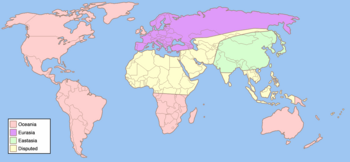
For anyone who wonders what Eastasia has been doing to keep up with Eurasia (the EU) and Oceania(moves towards a North American Union are afoot).

Currency blocs fall into place
Andrew Wood, Financial Times, November 22nd 2007


Asian central banks appear to be adopting similar monetary policies in a way that suggests they could be preparing for an eventual currency union for the region, according to Deutsche Bank.

Twelve Asia-Pacific currencies – including the yen, the Korean won, the Indian rupee and the Australian dollar – have increasingly traded as a bloc since 2005, the bank’s research has found.

There is an increase in the correlation between the value of Asian currencies as central banks try to keep their export-led economies competitive internationally and also reduce foreign exchange volatility within the region.

This trend is a result of the wider use of trade-weighted currency baskets in India, China, Singapore and Malaysia, the bank says, adding that the patterns show similarities to movements in some European Union currencies in the years before the euro was created in 1999.

“Asia is beginning to look a lot like Europe in the 1980s and the start of the 1990s,” said Martin Hohensee, Asian head of fixed income and credit research, who led the analysis.

“Policymakers and politicians are talking seriously about the possibility of Asian currency union, even if there isn’t a single currency,” he told the Financial Times in an interview.

Asia has a thickening network of free-trade agreements, creating conditions similar to Europe’s single market that paved the way for the euro. “Intraregional trade within Asia accounts for a similar share of total trade as was the case in Europe in 1992,” he said. The Asian Development bank has outlined plans for a possible Asian Currency Unit, similar to the European Currency Unit that preceded the euro.

But Mr Hohensee said that, unlike in Europe, there is much less political will for integration. Nevertheless, this week leaders of the 10 members of the Association of South-east Asian Nations agreed to remove trade barriers by 2015 to create a European Union-style economic community.

“What seems to be happening in Asia is an economic process that might become a political one,” Mr Hohensee said.

He did not think Asian central banks were deliberately colluding in setting monetary policy, but that informal co-operation would grow naturally. “I think every time central banks get together and talk they realise that volatility is in no one’s interest,” he said.

Deutsche Bank says the trend offers investors the chance to use similar strategies to those popular in the run-up to the euro, by betting that interest rates for high-yielding currencies will converge to the regional average. “This informal kind of monetary union by stealth is throwing up good investment opportunities,” Mr Hohensee said.

The bank is launching two Asian Convergence indices to track the trend. One is based on the nine non-Japanese regional currencies most likely to take part in any Asian currency union, and another broader index which includes the yen and the Australian dollar, as both countries are likely to be affected by any Asian regional currency policy.

Patterns begin to emerge


The chart shows the correlation between individual Asian currencies against the dollar and a basket of those currencies from 2000.

Of the 10 currencies measured by Deutsche Bank, eight have shown increased correlations since 2005 than the previous five years. Five have shown correlations of greater than 90 per cent since 2005: the Chinese renminbi, the Malaysian ringgit, the Philippine peso, the Singapore dollar (which has jumped from 10 per cent since 2005) and the Thai baht. The yen and the Taiwan dollar’s correlation to other currencies have turned negative since 2005, however.